Google sells a model platform and a chat box. Your team works in between.
Vertex AI is where your engineers build on models. Gemini Enterprise is where your staff chat with one. The layer a services firm actually needs sits between them: a shared room per client engagement, with a budget on it and your own expense code attached, running on whichever models you choose. Google does not sell that layer, and the two products it does sell each stop short of it from opposite directions.
Checked against Google's published documentation, September 2026. Sources listed at the foot of this page.
ParleHub runs on Gemini. It is one of the four provider families you can connect, alongside Anthropic, OpenAI, and Azure OpenAI, and it is a real, working provider with full tool calling, vision and PDF attachments, and streaming. This page is not an argument against Google's models.
One thing to get out of the way before you read the rest, because you will ask it in the first five minutes: there are two ways to connect Google models here. The Gemini Developer API takes a Google AI Studio key, the same one-key-per-provider shape as every other provider. Vertex AI is a separate provider you connect with your own Google Cloud credentials, so inference runs in your Cloud project, under your GCP contract, against your IAM, pinned to a region you choose. If your policy requires the second, it is supported rather than something to wait for; note that which models a region serves varies, so pick the region with the models you intend to use.
Three differences that change the answer
Which project the budget means
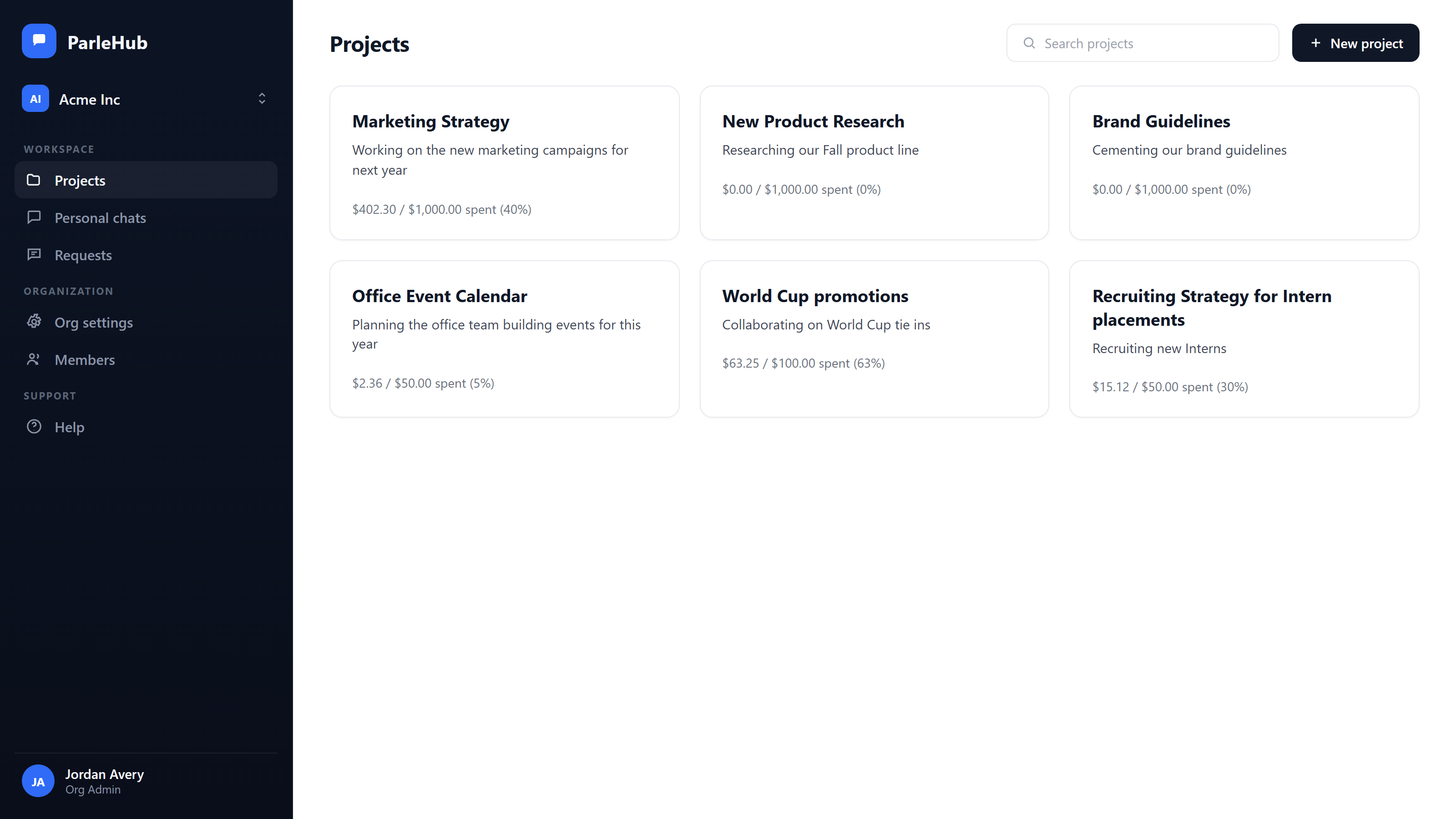
Google budgets a Cloud project, which is an infrastructure container your consultants never see. ParleHub budgets a project that is the engagement, matter, or account, created by the people doing the work.
What a shared conversation is
Sharing a Gemini Enterprise conversation creates a link to the content as it stood; the recipient sees nothing added afterwards. In ParleHub the thread stays live for everyone in the project.
Who has to assemble it
On Google the per-client answer is a project layout, labels, a BigQuery billing export, and someone who maintains all three. ParleHub ships the answer: a project code on the spend, in the export.
Google does budget per project. It is not your kind of project.
Cloud Billing gives every Google Cloud project a budget, and in preview a spend cap that blocks new usage of one eligible service in one project once the target is passed. That is a real control, and more than most vendors offer. The unit is a Cloud project: an infrastructure container with IAM, quotas, and an engineer who owns it. Running one per client matter means standing up and retiring cloud projects at the pace your firm opens and closes engagements.
Two details matter if a partner is relying on the number. Cloud spend cap enforcement runs on estimated costs and is not instantaneous, and in-flight requests complete after the cap trips. ParleHub checks before the send, so the block lands ahead of the spend rather than behind it.
- check_circle Budgets on the engagement, set by a project admin, no cloud console involved
- check_circle Pre-flight enforcement: the send is blocked before it runs, with a warning at 80%
- check_circle A project code on every project, carried into the CSV export, so cost reconciles without a BigQuery job
- check_circle Personal and org-wide caps underneath, and a one-click increase request routed to an admin
A snapshot of a conversation is not a conversation
Gemini Enterprise lets a user share a conversation, and Google's documentation is precise about what the recipient gets: the content as it stood when the link was made, with none of the prompts or responses that come after. Sharing is a deliberate act, one conversation at a time, and admins decide whether it is allowed at all. The result is a firm whose AI work is a pile of links of varying freshness, which is closer to emailing a document than to working in one.
- check_circle Every thread in a ParleHub project is visible to its members as it happens, with no share step
- check_circle Live presence shows who is viewing, typing, or waiting on a response, and the streamed reply appears to everyone watching
- check_circle Keyword and semantic search across every conversation in the project, so the work is findable a quarter later
- check_circle A useful personal chat can be promoted into the shared project
Neither product is aimed at the person doing client work
Vertex AI is a developer platform. It assumes an engineer, a cloud project, and something being built. A consultant with eleven exhibits and a deadline is not its user, and no amount of configuration turns it into their workspace.
Gemini Enterprise is aimed at that consultant, and it is good at being close to their mail and their documents. What it is not is organised around the engagement: there is no room where a matter team's work accumulates, carries a budget, and can be read by the person who joins in week three.
Vertex AI
Model plane. Engineers, cloud projects, quotas, IAM, billing exports. Stops before there is a workspace.
Gemini Enterprise
Chat plane. Individual users, per-seat licences, conversations shared as links. Stops before there is an engagement.
ParleHub
The layer between: shared threads per engagement, a budget and your expense code on each, files in your own Shared Drive, and Gemini as one of four providers underneath.
Standardising on one cloud's models is a decision you make once
Committing the workspace to a single vendor's model is cheap on the day you do it and expensive the day a competitor gets better at the work you sell. When the projects, the instructions, and the history live in that vendor's product, acting on the change means rebuilding all of it. ParleHub keeps the provider at the edge, so everything your team builds sits above it and does not move when the model does.
- check_circle Point one conversation at a different vendor's model when a single question needs it, keeping the thread, the project files, and the agent tooling
- check_circle Move a project or the whole organization onto another provider as a settings change; projects, threads, files, budgets, project codes, roles, and the audit trail are untouched
- check_circle Run Gemini for the work it wins on and something else for the rest, in the same workspace, on the same ledger
- check_circle Bring your own provider keys, or use models we host and pay by consumption, or run both at once
- check_circle Open-weight models included in what we host. Vertex will serve you those too, once an engineer has stood up a Cloud project; ours are a dropdown in the conversation your consultant is already in
- check_circle Your keys or ours, so moving spend to a cheaper model is a commercial decision rather than a migration project. The same budgets, caps, project codes and ledger apply either way
Google-native, without giving up the Google part
Moving your team's AI work off Google's own product does not mean moving your documents. A ParleHub Enterprise project can point at a named Google Shared Drive of yours, and the files stay in it: your retention policy, your permissions, your sharing rules. Sign-in runs through Google Workspace, so joiners and leavers are handled where they already are.
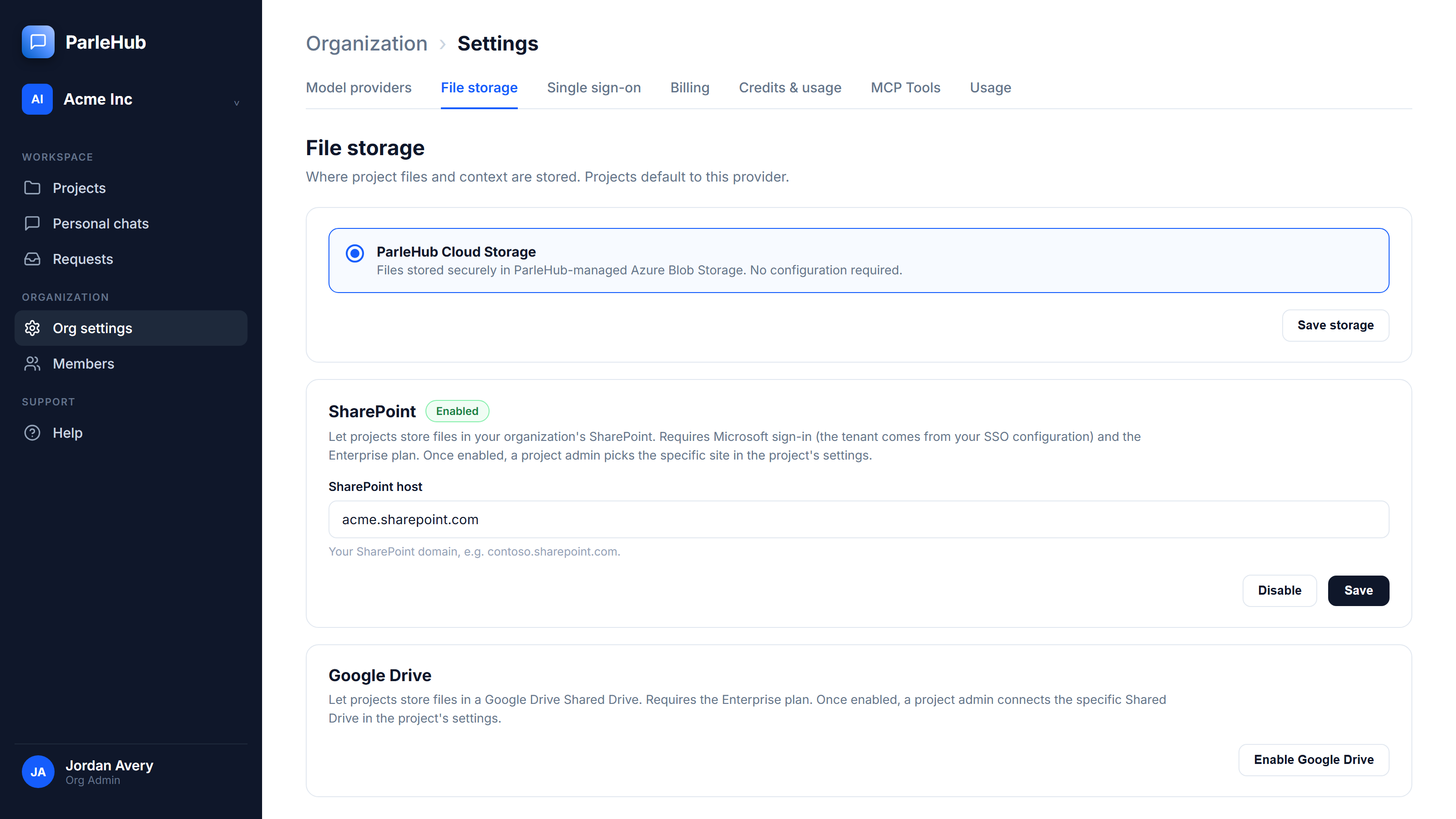
- check_circle Google Shared Drives as project storage, with native Drive search and Docs, Sheets, and Slides export, verified against a real production Drive
- check_circle Google Workspace single sign-on, verified in production, with SSO-only login enforceable org-wide
- check_circle SharePoint too, for the firms running both, and managed storage on every tier
- check_circle More detail on the whole control set on our security page
The full comparison
Gemini Enterprise and Vertex AI get their own columns because they are different products sold to different people, and merging them would flatter both. Described as documented by Google in September 2026.
| Capability | ParleHub | Gemini Enterprise | Vertex AI |
|---|---|---|---|
| Who it is built for | Teams billing client work | Individual Workspace users | Engineers building on models |
| Budget scoped to a client engagement | Yes, the project is the engagement | No | No; the unit is a Cloud project |
| Other budget scopes | Per user, org-wide | Per-seat licence, consumption beyond quota | Cloud project, per-project API quotas |
| Hard block on spend | Yes, pre-flight, warning at 80% | Via Cloud Billing, as at right | Spend cap budgets (preview): one project, one eligible service, monthly |
| Behaviour at the cap | Send blocked before it runs | As at right | New usage blocked, in-flight completes; enforcement not instantaneous, based on estimated cost |
| Self-serve increase request | Yes, routed to an admin | Admin licence change | Quota or budget change in the cloud console |
| Your expense code on spend | Project code field, carried into the CSV export | No | Labels, assembled by you via BigQuery billing export |
| Cost reporting dimensions | Project, person, provider, model | Admin usage reporting | Service, project, label, SKU |
| Usage export | CSV, no query to write | Admin reporting | BigQuery billing export |
| Team threads shared by default | Yes, every thread in the project | No; a shared conversation is a link to a point in time | No chat workspace |
| Later turns visible to the people you shared with | Yes, live | No | Not applicable |
| Live presence and streamed replies | Yes | No | Not applicable |
| Model choice | Gemini, Anthropic, OpenAI, Azure OpenAI on your own keys, plus open-weight models we host | Gemini | Gemini plus the Vertex model garden |
| Models you have no contract with | Available in the workspace, hosted by us, no procurement | No | Yes via the model garden, for engineers with a Cloud project |
| How we connect to Gemini | Either: a Gemini Developer API key, or Vertex AI on your own Cloud project credentials, region-pinned | Not applicable | Not applicable |
| Answering from the firm's own documents | One org-wide corpus bound to your SharePoint or Drive library, with a per-project opt-out. Citations name the document, its version and its section; retiring a version removes it from the index | Data stores over Drive, admin-scoped to chosen folders or shared drives | Data stores, built and scoped by an engineer |
| Cost of moving to a cheaper provider | A settings change; projects, threads, files, budgets and roles stay put | Rebuild the workspace elsewhere | Rebuild the integration |
| How model usage is paid for | Your choice: on your own provider contract at your rate, or by consumption on models we host, with no key at all | Seat includes a quota; consumption charged beyond it | Metered, on your Google Cloud contract |
| Project files in your own tenant | Google Shared Drive or SharePoint (Enterprise) | Workspace-native | You build it |
| Single sign-on | Google Workspace, Microsoft Entra ID (Team & Enterprise) | Google Workspace | Google Cloud IAM |
| Audit log | Append-only, enforced at the core platform level | Workspace admin audit | Cloud Audit Logs |
Three reasons to stay on Google
A comparison page that finds nothing good to say about the other product is a sales sheet. These are the cases where we would tell you to buy Google.
- arrow_right_alt You want AI inside Docs, Gmail, and Meet. Gemini Enterprise sits in the tools your staff already have open all day. ParleHub is a separate place your team goes on purpose, which is the trade for having the work accumulate somewhere the firm owns.
- arrow_right_alt You are building a product, not running engagements. Vertex is a developer platform with training, tuning, endpoints, and a model garden. ParleHub is not a developer platform and has no coding harness.
- arrow_right_alt You want a quota in the seat price. A Gemini Enterprise seat carries a usage quota before anything is metered, on the same Google bill as the rest of Workspace. We can host your models with no key to manage, but hosted usage is charged by consumption from the first token, which is a different budgeting shape.
The other two head-to-heads
The same questions, asked of Anthropic's and OpenAI's team products.
Every claim about Google on this page comes from Google's own documentation, read in September 2026. Products move; if something here has gone out of date, we would rather fix it than keep it.
- Gemini Enterprise: share your conversations
- Cloud Billing: manage spend cap budgets
- Cloud Billing controls for generative AI use cases
- Admin controls for Gemini Enterprise in the Workspace Admin console
- Set up a Google Drive data store for Gemini Enterprise
Google, Gemini, Google Workspace, Google Cloud, and Vertex AI are trademarks of Google LLC. ParleHub is not affiliated with or endorsed by Google.
Keep the models. Move the workspace.
Connect a Gemini key, sign in with Google Workspace, point a project at one of your Shared Drives, and give it a budget and a code. The first export tells you whether the argument holds.
Start free at app.parlehub.com arrow_forward